

Lesson 3
Now that we've drawn enough slopes, and you are happy that your slopes are all the same distance apart and all the same slope forward, and that everything looks nice, we are ready for the next thing. It's not a letter.
When we write cursive, we need to learn how to connect the letters. And this connecting slope is called a ligature.
And there's something else we need to learn how to do, and it's quite difficult, and that is to change the pressure that we push down on the page. Because when we write cursive, we alter the pressure of the stroke of our pen. And we go light up, dark down. Remember that: light up, dark down. On the way up, we don't press hard. On the way down, we do press hard. And that means the downstrokes are much stronger than the lighter upstrokes, because the upstrokes generally are not part of the shape of the letter, but are the connecting strokes. They are important, but we don't want them to be too strong.
Now, in the next lesson, we are going to do something that's quite difficult. And if we master it, then everything after this will become a lot easier.
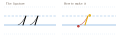
So you can see the diagram. There is an upstroke, which is in red, and a downstroke, which is in yellow. That downstroke you've been practising for a long time. But what we're going to do is add a connecting stroke to it.
Now, you look at this and say, oh, that's really simple. But it is not. Because what will happen is that your angles, that you thought you had mastered before and got beautifully equal, will suddenly become unequal.
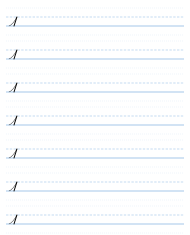
So what you need to do is this. You need to make a copy of it: light up, dark down. And then leave a small space, just a little space between them, and start again: light up, dark down. And then check with your ruler that the two vertical lines, your i's, your slopes, are the same slope. And then make another: light up, dark down. And then check the spacing.
Now, what might happen is you might find that your up-down slope, your i, will start to bend. We don't want that. We want to keep it straight. You might find that it starts to get shorter and shorter and shorter, and doesn't come up and hit the top of the line. We don't want that. You need to keep everything the right height, the right angle, and the right distance apart. Everything nice and equally spaced, and light on the way up, and push hard on the way down.
And as you get good at it, you'll start to find you have a rhythm. Light up, dark down. Light up, dark down. Say it out loud in the beginning while you are doing this.
Cursive — Part One: The Small Letters · Evan Millner · Published by Abecedaria Press