

Latinum Press · The Latinum Method
The Latinum Method
The Latinum Institute Reading System
Latinum Institute · 9 November 2024
The language reading system you see here at the Latinum Institute Substack has been in use in one form or another for over 2000 years.
The method is based on the learning process that was promoted by the Enlightenment philosopher John Locke (author of An Essay Concerning Human Understanding, and Two Treatises of Government). Similar methodologies were used in English editions of John Amos Comenius, Desiderius Erasmus and Mathurin Corderius.
However, their production was difficult, not only requiring a specialised linguistic facility to make an effective construed text; also the typesetting of these specialised texts was expensive, and so very few were made. This type of learning text was designed as a formatting scheme to maximise the amount of information available to the reader of a foreign language.
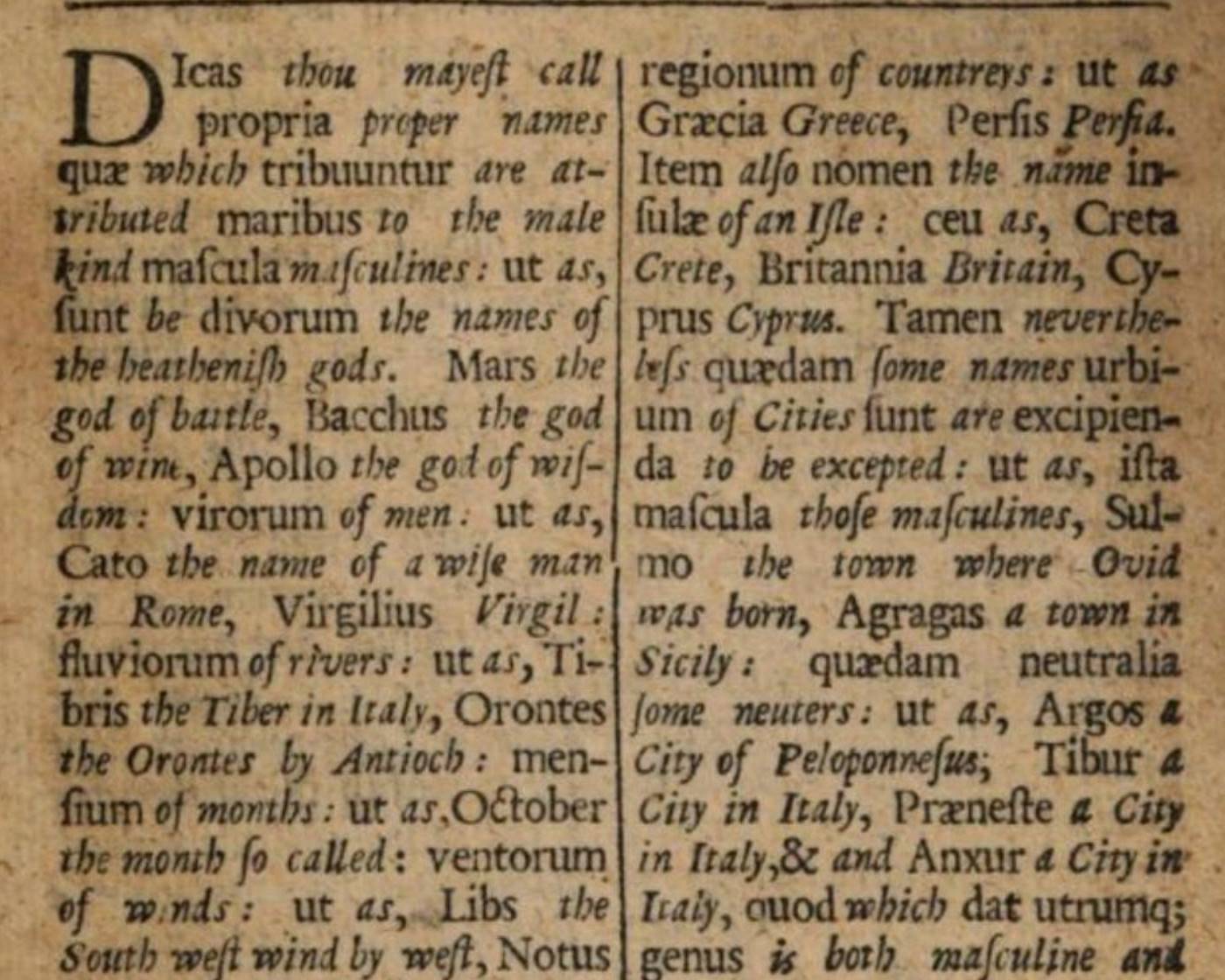
Lilie’s Rules, William Haines edition, London 1703
James Hamilton and his son-in-law J.W.Underwood were among the last publishers in a long line stretching back to hoary antiquity using this remarkable method for teaching languages, based around studying texts with glosses and interlinear translations. For example, the medieval manuscript of the Rule of St Benet contains interlinear versions in Anglo-Saxon. Bilingual study texts in Latin and Greek exist dating back to the second century. This method was used in some form or another for over 4000 years.

AO5477 is a Sumerian-Akkadian bilingual text, c. 2279–2270 BC
The philosopher John Stuart Mill tells us in his Autobiography (1873) that he learned German through this bilingual “Hamiltonian System”.
John Amos Comenius (seventeenth century) and the philosopher John Locke in the eighteenth century were strong advocates of this system of teaching language though text, by reading. By the early twentieth century the method of using specialised construed texts had disappeared from educational establishments, and even from private instruction.
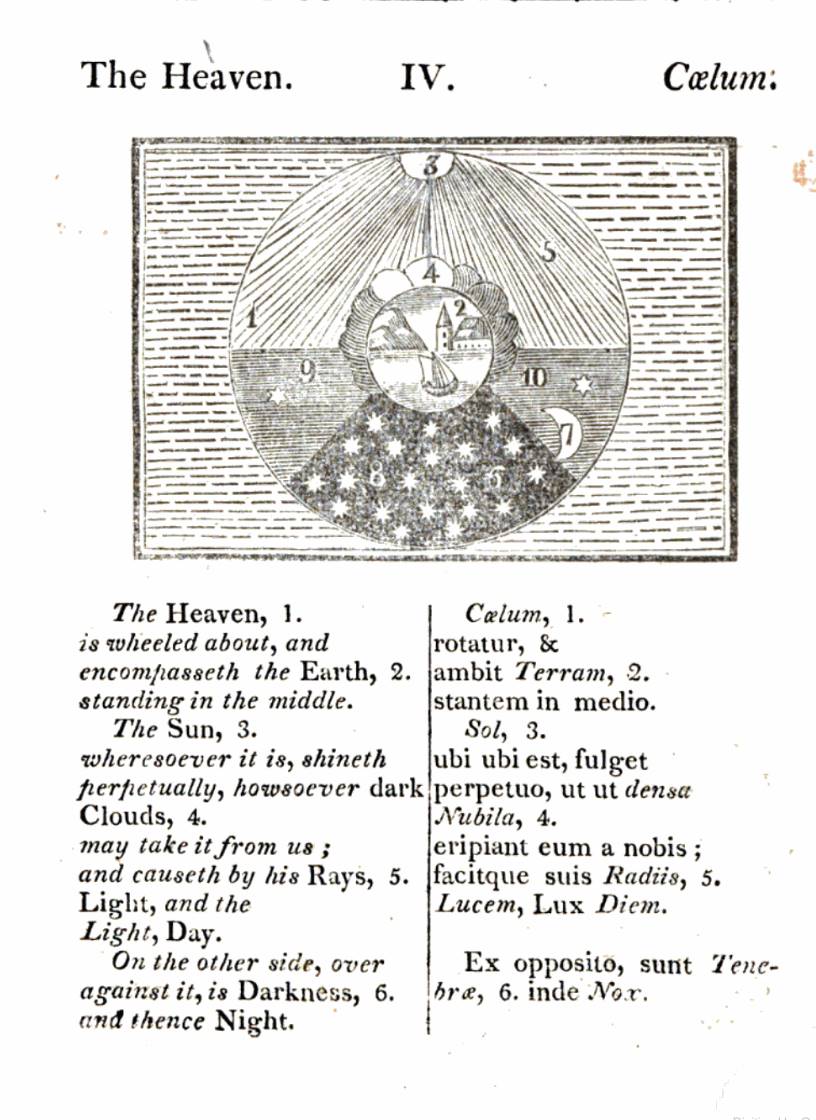
The Visual World in Pictures, John Amos Comenius, Charles Hoole edition, London 1810
Even today, almost no students know about this method, despite its evident success as a practical system. The linguistic purists of the late 1800’s did not like the deformities created by the construed (interleaved/alternating languages) textual method. With a focus on teaching grammar, the linguistic gymnastics needed to create a useful study text in two languages on the same page, interleaved, horrified them. However, as John Locke, the father of empiricism would have said, ‘the proof of the pudding is in the eating’ - if the system works - and it does - then ideology about grammatical purity should play no role.
WORDS -WORDS -WORDS
Comenius recognised that the main problem with getting to grips with a foreign language was not, oddly enough, the grammar, but the vocabulary.
To this end, he devoted a huge amount of time creating specialist texts such as the Januae Latinitatis Vestibulum, the Orbis Sensualium Pictus, the Januae Latinitatis Fundamentum, the Janua Linguarum Reserata, the Schola Ludus and others to help a student acquire the 10,000 or so words needed at a minimum to be able to read. Another author active in this area was Michael Pexenfelder, whose Apparatus Eruditionis was also written to help students learn the massive vocabulary needed to be able to read.
We now know that Comenius was correct, as Ernest Blum wrote in his 2008 essay, “The New Old Way of Learning Languages”, September 1, 2008
" In the last half of the 20th century, an explosion of computer-based studies of large texts, called “corpora,” has demonstrated that the number of words needed to read foreign-language books exceeds by several multiples the amount of vocabulary that is acquired by most foreign-language students. This huge vocabulary gap explains why it is impossible for most students to read extensive, sophisticated materials in foreign languages. Even many who are academically involved with foreign languages must depend heavily on dictionaries, consult translations, and accept reading with blind spots because of time constraints. "
The main problem with mastering a foreign language is that once one leaves the high-frequency words of daily conversation behind, a student wanting to gain command of that foreign language has a massive problem. Almost all the words outside of this small group are low-frequency words. This is the effect of what is knows as Zipf’s Law - that almost all words you will encounter in your reading of a literary text will be rare - up to twenty words on an average printed page of a typical novel, for example.
More saliently, the more unusual and rare a word is in a sentence, the more important that word is likely to be, in terms of overall meaning.

The most common word occurs approximately twice as often as the next most common one, three times as often as the third most common, and so on, until the task facing the second language learner becomes very difficult.
The Latinum Institute has long wanted to make modern versions of various language texts using this method - and now, with the advent of artificial intelligence systems, a task that would be horrendously expensive and time consuming can be done.
Training the systems to carry out this formatting work without error was not easy at all. It is not simply a matter of mashing the two languages together - the syntax of both languages has to be taken into account, with adjustments to the natural word order where needed for constructing the construed text, while retaining mutual intelligibility and consistency. We commenced intensive AI training in March 2023, and only now, after much effort and trial and error, in the final month of 2024, after extensive testing and training, are we confident in the ability of the systems to perform.
Each lesson is unique, and made specifically for both the culture of the learner, and the culture of the language being studied.
We have adapted the system and developed it to rapidly get you independently reading. With constant reading of these lessons and texts, you will quickly and, more importantly, enjoyably, develop your language reading skills, and build a large vocabulary. The system we are using here gets you reading extensively from day one. “Reading”, wrote Hamilton, “is the only real, the only effectual source of instruction... it is the pure spring of nine-tenths of our intellectual enjoyments. . . . neither should it be sacrificed to grammar or composition, nor to getting by heart any thing whatever, because these are utterly unobtainable before we have read a great deal.”
ACADEMIC RESEARCH
Although this method fell out of use in most countries, it continues to be found in a few Asian education systems. Some research exists showing the effectiveness of this interlinear glossed system for rapid vocabulary learning.
Interlinear glosses have a noticeably better effect on vocabulary recall compared to post-text glosses
A Comparison of Interlinear and Parallel Translated Texts as Scaffolds for L2 Reading Comprehension
First published on the Latinum Institute Substack, 9 November 2024.

The Latinum Institute · Latinum Press